
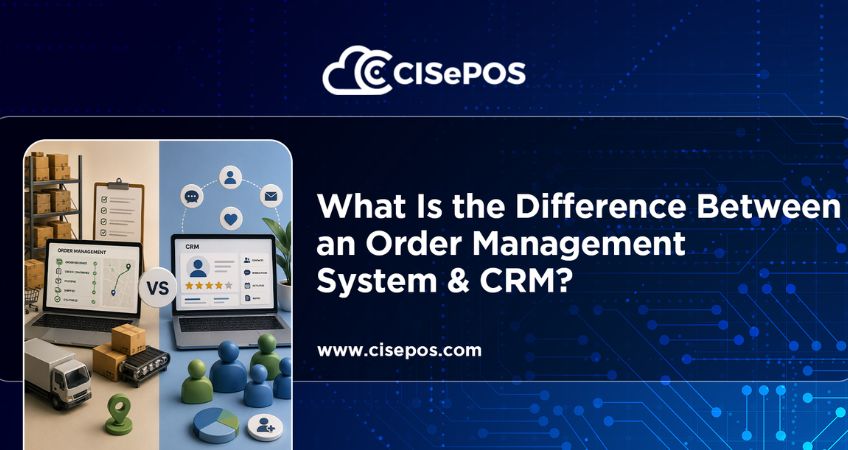
Many businesses invest in software to improve efficiency, but choosing the right solution can be confusing. Two of the most commonly compared systems are an order management system (OMS) and a Customer Relationship Management (CRM) system. While both help businesses organize their operations, they serve different purposes.
A CRM helps businesses build stronger customer relationships and manage sales interactions. An order management system focuses on what happens after a customer places an order. It manages everything from order processing and inventory updates to invoicing, shipping, and delivery.
In simple terms:
- A CRM helps you manage people.
- An order management system helps you manage orders.
Businesses that understand this difference can choose software that supports their long-term goals instead of solving only part of the problem.
In this guide, we explain how each system works, where they differ, and why many growing businesses use both. CISePOS helps businesses streamline operations with an efficient management solution.
What Is an Order Management System?
An order management system is software that manages the complete lifecycle of an order. It starts when a customer places an order and continues until the product reaches the customer.
Businesses can handle orders, inventory, payments, invoices, and shipping all in one platform, rather than using spreadsheets or multiple tools. This leads to streamlined processes and less manual work.
A modern OMS also works as order processing software, helping businesses process orders faster while reducing human error. Every department can access the same information, which makes collaboration easier and improves overall efficiency.
With solutions like CISePOS, businesses can simplify daily operations by managing orders, inventory, billing, and buyer information from a single centralized platform.
Key features of an OMS include:
- Centralized order management: Manage orders from multiple sales channels, including online stores, physical outlets, and phone orders, through a single dashboard for better visibility and control.
- Real-time inventory updates: Inventory levels update automatically as orders are placed, fulfilled, or returned. This helps businesses maintain accurate stock records and prevent overselling.
- Automated order processing: Streamline the entire lifecycle by automating tasks like order confirmation, invoicing, fulfillment, and shipping, reducing manual effort and improving efficiency.
What Is a CRM?
A Customer Relationship Management system, or CRM, is designed to manage customer interactions throughout the sales journey. It stores customer details, communication history, sales opportunities, and follow-up activities in one place.
Sales and marketing teams employ a CRM to understand buyers’ needs, nurture leads, and improve customer relationships. Customer support teams also use it to provide faster and more personalized service.
Although a CRM may record previous purchases, it does not manage inventory, shipping, or order fulfillment. Its primary goal is to strengthen customer engagement rather than manage operational workflows.
Key features of a CRM include:
- Centralized customer information: Store buyers’ contact details, purchase history, communication records, and preferences in one place for easy access.
- Automated customer follow-ups: Schedule reminders for follow-ups, promotional campaigns, and customer engagement activities to ensure timely communication.
- Customer insights and sales tracking: Analyze customer behavior, buying patterns, and sales performance to make informed decisions and create more personalized buyer experiences.
Key Differences Between an Order Management System and CRM
Primary Purpose
A CRM improves customer engagement and helps sales teams build lasting relationships. An OMS improves operational efficiency by managing every stage of the order lifecycle.
Information Managed
CRM platforms store buyer profiles, communication records, sales activities, and support history. An OMS stores order details, payment information, inventory records, invoices, shipment status, and delivery updates.
Teams That Use Them
Sales, marketing, and customer support teams rely on CRM software. Operations teams, warehouse staff, finance departments, and fulfillment teams depend on a sales OMS to manage daily business operations.
Inventory Management
Most CRM platforms offer very limited inventory features. While an OMS supports inventory and order management by updating stock levels automatically whenever orders are placed, fulfilled, or returned. This helps businesses avoid overselling and maintain accurate inventory records.
Order Visibility
Customers expect updates after placing an order. An integrated order-tracking system gives both customers and staff real-time visibility into order status, reducing customer inquiries and improving satisfaction.
Benefits of an Order Management System and CRM
Both systems help businesses improve efficiency, but they deliver value in different areas.
OMS
- Faster order processing: Automates order confirmation, invoicing, and fulfillment.
- Accurate inventory management: Keeps stock levels updated in real time to prevent overselling.
- Fewer operational errors: Reduces manual data entry and order processing mistakes.
- Better customer experience: Provides timely order updates through an order tracking system.
- Smarter decision-making: Offers real-time reports on sales, inventory, and order performance.
CRM
- Stronger customer relationships: Stores customer history and preferences in one place.
- Improved sales management: Helps teams track leads and close opportunities more effectively.
- Faster customer support: Gives support teams instant access to customer information 24/7.
- Better team collaboration: Keeps sales, marketing, and support teams aligned.
- Actionable business insights: Tracks buyers’ behavior and sales trends to support informed decisions.
Do You Need an OMS, a CRM, or Both?
The right choice depends on your business needs and current challenges.
- Choose a CRM if your main focus is managing leads, improving customer communication, and growing sales.
- Choose an order management system if your biggest challenges involve processing orders, managing inventory, tracking deliveries, or reducing operational errors.
Many growing businesses benefit from both systems because customer relationships and order fulfillment are equally important. While a CRM helps bring in customers, an OMS ensures every order is fulfilled accurately and on time.
Why Businesses Need Both Systems
An OMS and a CRM are not competitors. They solve different business challenges and work best when used together.
A CRM helps attract customers, manage leads, and strengthen relationships. Once a customer places an order, the order management system takes over by processing the order, updating inventory, generating invoices, and tracking delivery.
Using both systems gives businesses complete visibility into the customer journey, from the first interaction to the final delivery. Teams can work more efficiently because buyer information and operational data remain connected.
Businesses that use CISePOS benefit from this connected approach. Instead of switching between multiple tools, they can manage orders, billing, inventory, and customer information through one centralized platform, creating a smoother workflow across all departments.
Why Businesses Are Moving to Online Order Management Software
Customer expectations continue to grow. Businesses now receive orders from websites, physical stores, mobile apps, and online marketplaces. Managing these orders manually often leads to delays, inventory issues, and unnecessary errors.
Online order management software brings every order into one centralized dashboard. Teams can process orders faster, update inventory automatically, generate invoices, and monitor shipments without moving between multiple systems.
How CISePOS Simplifies Order Management
Managing orders becomes more challenging as a business grows. More products, more customers, and more sales channels require better organization and greater visibility.
CISePOS helps businesses overcome these challenges by providing a reliable system that streamlines daily operations. Businesses can manage orders, inventory, billing, and buyer information from one platform, reducing manual work and improving efficiency.
With built-in support for inventory and order management, businesses always know what products are available and can avoid stock-related issues. The system also serves as order-processing software, helping teams process orders quickly while reducing errors.
Whether you run a retail store, restaurant, or wholesale business, CISePOS gives your team the tools to manage orders confidently while delivering a better buyer experience.
Conclusion
Choosing between a CRM and an order management system does not have to be difficult once you understand what each solution is designed to do.
For many businesses, the best solution is not to choose one over the other but to use both together. They support different parts of the business and form a smoother experience for employees and customers alike.
CISePOS helps businesses simplify operations, reduce manual work, and stay prepared for long-term growth.
FAQs
Q1: Can a CRM replace an order management system?
A: No. A CRM manages customer relationships and sales activities, while an order management system handles order processing, inventory, fulfillment, and delivery.
Q2: Do I need a CRM if I already use an order management system?
A: Yes, if repeat customers matter to your business. An OMS handles fulfillment, but only a CRM tracks who your customers are and brings them back.
Q3: Can a small business run without an order management system?
A: Yes, a small business can operate without an OMS, but only if you have low order volumes, a single sales channel, and a small inventory; then you can manage orders effectively using basic spreadsheets or order-tracking tools.