
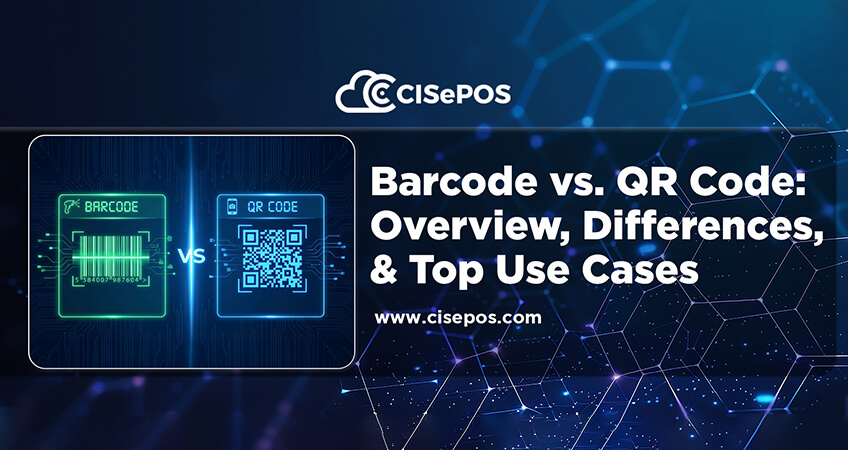
The Barcode Vs QR Code Debate
In today’s fast paced, digitized world, the two most important factors are speed and security. This holds more true for businesses than any other organization. They rely heavily on machine readable codes to perform a number of tasks for them. These include tracking products, sharing information, and improving customer experiences. To that end, two technologies are used more than any other. Hence, giving rise to the barcode vs QR code debate.
Although both of them serve similar purposes, there is a distinction between them. Both of them boast a unique structure, capacity, functionality, and use cases. Not only that, but their design makes them more suitable for some businesses than others. That’s why it is important to learn about them and how they function. Thus, giving a business optimal chances of succeeding in an incredibly tough market.
What Is a Barcode?
It is a visual representation of data using a series of parallel lines (bars) and spaces of varying widths. Moreover, these lines encode numeric or alphanumeric information that can be read by a barcode scanner. Introduced in the 1970s, they are commonly found on product packaging, enabling quick price lookup and inventory management. Here are some of the key features that help distinguish it from its counterpart:
- Typically one-dimensional (1D)
- Stores limited data (usually numbers)
- Requires a laser or optical scanner
- Must be scanned horizontally
- Widely used in retail and logistics
Definition Of A QR Code
Before we can make any comparisons in the barcode vs QR code debate, it is important to understand both. The latter refers to a two-dimensional (2D) matrix barcode made up of black squares arranged on a white background. Furthermore, it was developed in Japan in the 1990s to store larger amounts of data. Additionally, it helped people to scan items quickly. Here are some of its key characteristics.
- Two dimensional structure
- Can store thousands of characters
- Readable from any direction
- Scannable using smartphones
- Supports text, URLs, images, and more
Examining Differences In The Barcode Vs QR Code Debate
Now that we know what both of these technologies are, we will examine how they are different from one another. Moreover, this dissimilarity goes beyond appearance. Some of the main distinctions are as follows:
1. Data Capacity:
- Barcode: Typically holds 8 to 20 characters
- QR Code: Can store up to 7,000 numeric characters or 4,000 alphanumeric characters
2. Data Types Supported:
- Barcodes: Mostly numbers (e.g., product IDs)
- QR Codes: Text, URLs, emails, phone numbers, payment data, Wi-Fi credentials
3. Scanning Technology:
- Barcodes: Require specialized scanners
- QR Codes: It is possible to scan them using smartphone cameras
4. Error Correction:
- Barcodes: Minimal error tolerance
- QR Codes: Built in error correction allows scanning even if part of the code is damaged
5. Orientation and Speed
- Barcodes: It requires perfect alignment
- QR Codes: A user can scan it from any angle
Common Types of QR Codes and Their Uses
Understanding where QR codes are most impactful can help businesses make informed decisions regarding their suitability.
1. URL QR Codes:
- Open websites, landing pages, or menus
- Used in marketing, restaurants, and advertising
2. Text QR Codes:
- Display plain text messages
- Useful for instructions or short information
3. Wi-Fi QR Codes:
- Automatically connect devices to Wi-Fi
- Common in cafes, hotels, and offices
4. Payment QR Codes:
- Enable digital payments
- Used in banking, e-commerce, and POS systems
5. Contact (vCard) QR Codes:
- Save contact details directly to phones
- Ideal for business cards and networking
6. App Download QR Codes:
- Direct users to app stores
- Used in mobile app marketing
Top Use Cases of Barcodes
Although many people argue that there are more advanced technologies available now, barcodes remain a staple in many industries. Let’s take a closer look at how they are used in each of them.
1. Retail:
- Product identification
- Price scanning
- Inventory tracking
2. Logistics & Warehousing:
- Shipment tracking
- Stock control
- Asset management
3. Healthcare:
- Patient wristbands
- Medication tracking
- Lab sample identification
4. Manufacturing:
- Component tracking
- Quality control
Top Use Cases of QR Codes
On the other hand, QR codes shine brighter in specific industries than others. Here’s a look at some of them.
1. Marketing & Advertising:
- Campaign tracking
- Promotions
- Event check-ins
2. Restaurants:
- Digital menus
- Table ordering
- Customer feedback
3. Payments:
- Mobile wallets
- Contactless transactions
4. Education:
- Access learning materials
- Attendance tracking
5. Authentication & Security:
- Login verification
- Access control
Security Considerations
Inarguably, the most important aspect of integrating technologies in businesses is how safe they are. Regardless of how innovative or profitable something is, it will not become a part of business operations without being secure. Hence, here are some security considerations in the barcode vs QR code debate.
Barcodes:
- Limited data reduces misuse risk
- Not encrypted
- Easy to duplicate
QR Codes
- Can store sensitive data
- May redirect to malicious links if not verified
- Should be generated and managed securely
Which Is Better QR Code or Barcode?
Now that we have evaluated the barcode vs QR code discussion in detail, it is time to make the final verdict. Which is the better of the two? The answer to that is not a straightforward one. Both of them are more useful in certain situations. Thus, the right choice depends on the case in question. Let’s take a closer look at where both of them are preferred:
QR Codes Are Better When:
- Large or complex data requires storage
- Users will scan using smartphones
- Interactive features are required for various purposes (links, payments, downloads)
- Space is limited
- Error correction is important
Barcodes Are Better When:
- Only need a product ID or SKU
- High speed retail scanning is required
- Existing barcode infrastructure is in place
- Costs must be kept extremely low
Conclusion
At the end of the day, there is no stopping the barcode vs QR code debate. Defenders of both of these technologies will keep on listing why either is the better option. However, what is important to understand is that both of them possess dynamic features. If applied correctly, it can transform a business’s operation. Turning it from a manual heavy nature to a digitized, efficient one. Thus, making the barcode vs QR code discussion useful.
FAQs
Q: Are QR code and bar code the same?
A: No. QR codes are a type of 2D barcode. However, they offer significantly more functionality and data capacity.
Q: Which is better: QR code or barcode?
A: QR codes are better for digital, interactive use cases. Meanwhile, barcodes are ideal for fast retail and inventory scanning.
Q: What is the main difference between barcode and QR code?
A: The main difference is data capacity and functionality. The latter stores more data and supports digital interaction.
Q: What is the definition of QR code?
A: A QR code is a two-dimensional, machine-readable code. Moreover, it stores data and can be scanned using smartphones or scanners.
Q: What are common types of QR codes and their uses?
A: Common types include URL, payment, Wi-Fi, contact, and app download QR codes. Additionally, each of them is used for fast digital access.